Arabic voice AI that answers in the dialect the caller speaks.

A caller from Riyadh, one from Cairo and one from Tunis use three different sound patterns for the same request, and a voice model tuned only to news Arabic hears them all as noise. Nateq's voice agent takes its first dialect hint from the caller's number, follows how the caller speaks, and answers on phone calls and on the voice notes customers send.

  • Egyptian, Gulf, Levantine and Maghrebi
  • WhatsApp voice notes
  • Arabic and English in one call
  • Summaries your team can skim
14-day free trial · No credit card required

In short

Nateq's Arabic voice AI answers phone calls and WhatsApp voice notes in the dialect the caller speaks: Egyptian, Gulf, Levantine or Maghrebi, with Modern Standard Arabic as the base. It takes a first dialect hint from the caller's number, handles Arabic and English in one sentence, and hands a call to a person with its transcript when someone is free.

What you get

  • Dialects, beyond broadcast Arabic

    Egyptian, Gulf, Levantine and Maghrebi speech differ in vowels, speed and vocabulary. The agent is told to match the caller's dialect, so an Egyptian caller hears Egyptian Arabic and not formal Arabic.

  • Voice notes are the real channel

    A large share of support in the region arrives as a WhatsApp voice note, not a phone call. Each note is transcribed once, the dialect is saved with the transcript, and the reply goes into the same thread.

  • Code-switching mid-sentence

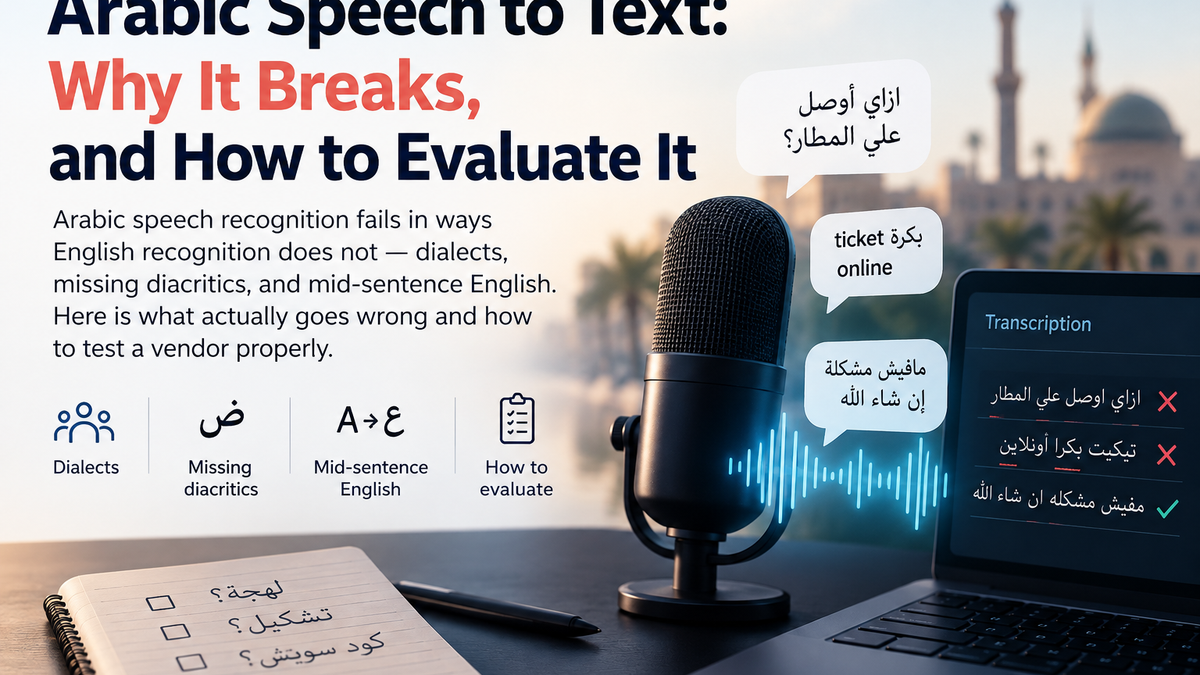
    Callers drop English product names, numbers and dates into Arabic sentences. The speech model is set to Arabic with English as a second language, because that is how these calls are spoken.

  • Same knowledge as every other channel

    The voice agent answers from the same knowledge base as chat and email, so a policy you update once is what the caller hears. There is no separate phone script to keep in step.

  • Transcripts and summaries

    Calls are transcribed and summarised after they end, so the next person to touch the ticket reads a paragraph instead of replaying eleven minutes of audio.

  • Handover that keeps the context

    When a call moves to a person, the agent passes the transcript so far and the reason for the transfer, so the customer is not asked to explain it a second time.

How does a call get its dialect?

Before the caller says anything, the agent knows the dialect their number suggests: Egyptian, Gulf, Levantine or Maghrebi. An Egyptian number gets Egyptian Arabic from the first reply, instead of formal Arabic until the caller has said enough to tell. That is a starting point, not a verdict. From then on the agent answers the way the caller speaks, and switches when they switch.

The spoken voice follows the language too. You can assign a voice to each language or dialect a workspace takes calls in, so an Egyptian reply is read by an Egyptian voice.

Does it understand English words spoken inside Arabic?

Yes, that is the design. The live transcript is set up with Arabic as the main language and English as the second, so an English product name in an Arabic sentence is kept in English rather than forced into Arabic letters. The agent is also instructed that transcripts sometimes spell English words in Arabic letters, so it reads such words by their sound.

If the meaning is still unclear, the agent asks the caller to repeat it and does not guess an order number or a time.

How do WhatsApp voice notes get answered?

A voice note is transcribed once after upload, and the transcript and its dialect are saved on the message. The AI reply is written from that transcript, so what the agent answers is what the customer sees in the thread. Nothing is parked for a person to play back later, unless the case needs one.

Will it understand my customers' dialect?

Yes. The voice agent understands Gulf, Egyptian, Levantine and Maghrebi Arabic, Modern Standard Arabic and English, including callers who switch between Arabic and English mid-sentence. It takes a first hint from the country of the caller's number, then follows the way the caller actually speaks and answers in the same register. Every call keeps a saved transcript, and every voice note keeps its transcript and detected dialect, so your team can read back exactly what was said.

When does a call go to a person?

The agent escalates when the caller asks for a person, when its confidence is low, when a keyword you set appears, when the caller stays silent too long, or when a supervisor takes the call. The backend decides whether a transfer can happen, based on whether the team is open and someone eligible is online. The voice agent never says a person is available on its own judgement.

Where Arabic voice AI gets used

  • A Gulf caller at night

    A customer asks when a delivery arrives. The agent answers from the delivery policy in the knowledge base, in Gulf Arabic, and nobody on the team had to be awake.

  • An Egyptian voice note about a damaged order

    The customer describes the damage in a voice note. It is transcribed into the thread, the reply comes back in the same dialect, and the case is routed to a person with the transcript.

  • A product name in the middle of a sentence

    The caller says they want to upgrade to the business plan in an Arabic sentence. The English name is kept as spoken, and the agent answers about that plan from the knowledge base.

  • A caller who wants a manager

    The caller asks for a manager. If one is free, the call transfers with the transcript. If not, the caller is offered a callback window, or a ticket is opened.

  • A busy afternoon on the calls board

    The wallboard shows calls waiting, the longest wait and the service level for the day, so a supervisor can see the queue building and act on it.

Nateq vs a menu-driven IVR or an English-first voice bot

The common options: a press-one menu that routes calls by key, or a voice bot whose speech model was tuned for news Arabic and English.

What mattersNateqA menu-driven IVR or an English-first voice bot
Caller's dialectAnswers in the dialect the caller speaks, from the first reply.Asks the caller to press a key, or answers in formal Arabic.
Voice notesTranscribed and answered in the same WhatsApp thread.Usually not handled, so a person listens to them later.
Arabic and English in one sentenceMixed speech is transcribed with both languages kept.Mixed speech is often misheard, and the caller repeats the same words.
AnswersThe same knowledge base as chat and email.A separate script that drifts from the website's information.
HandoverTransfers with the transcript so far, or offers a callback window or a ticket.Transfers blind, or dead-ends in a queue with no one on the line.

Live in three steps

  1. 1

    Connect a number or a channel

    Bring a phone line into the inbox, switch on WhatsApp voice notes, or both. Voice lands beside chat, email and social rather than in a separate system.

  2. 2

    Point it at your knowledge

    The voice agent answers from the same articles and policies as every other channel, so there is no phone script to keep in sync with the help centre.

  3. 3

    Set when a human picks up

    Choose the keywords and topics that always route to a person, and the points at which a call should transfer. The agent hands over the transcript so far with it.

Frequently asked questions

Which Arabic dialects does the voice AI handle?

Egyptian, Gulf, Levantine and Maghrebi speech, with Modern Standard Arabic as the base. The number's country gives the first hint, and the agent then follows the caller's own speech. Nateq publishes no accuracy figure per dialect, so test with your customers' recordings before you rely on it.

Does it work on WhatsApp voice notes, or only phone calls?

Both. Voice notes are the more common shape of support in the region, so each one is transcribed once and answered inside the thread the customer sent it in, rather than queued for someone to play back. A note with no intelligible speech is marked that way, so nobody is asked to listen to silence.

Can customers call our WhatsApp number and talk to the AI?

Yes. A customer taps call on your business's WhatsApp number and the AI answers in their dialect. Meta charges nothing for calls customers start, so the only charge is your Nateq AI voice minutes. Calls you place to customers on WhatsApp are billed by Meta to your own WhatsApp Business Account per minute, by the recipient's country, with no markup from Nateq.

Is call recording included, and how long are recordings kept?

Call recording is included free. Recordings are kept for 7 days on Basic and 90 days on Team and above, and you can set a shorter period for each number. Every recorded call starts with a notice that the call may be recorded.

What happens when a caller mixes Arabic and English?

The transcript keeps both. The speech model treats English as a second language, and the agent reads English names by their sound. Product names, order numbers and dates are routinely said in English inside an Arabic sentence, so treating the switch as an error would break most real conversations in the Gulf.

Do I need a separate script for the phone?

No. Voice reads from the same knowledge base as chat, email and social, so updating an article updates what callers hear. That is the point of running voice inside the same platform rather than bolting on a separate IVR. Each product change then needs one update, not two scripts that drift apart.

Can a call move to a human without losing context?

Yes. The transcript so far and the reason for the transfer go with it, so the person who takes the call starts knowing what has already been said. The transfer happens only when the team is open and someone eligible is online.

What happens if no one is free to take the call?

The voice agent says so plainly and does not pretend a person is coming. It offers a callback window, on WhatsApp or the phone number, or it opens a ticket so the team picks the case up later. Either way the caller is not left on hold with no next step.

How is this different from your Calls channel page?

Calls describes the channel: bringing voice and video into the shared inbox, with recording and summaries. This page is about the Arabic handling underneath it: which dialects the agent answers in, how voice notes are transcribed, and how mixed-language speech is handled.

Ready to see it in action?

Bring every conversation into one intelligent platform. Try it free for 14 days — no card required.