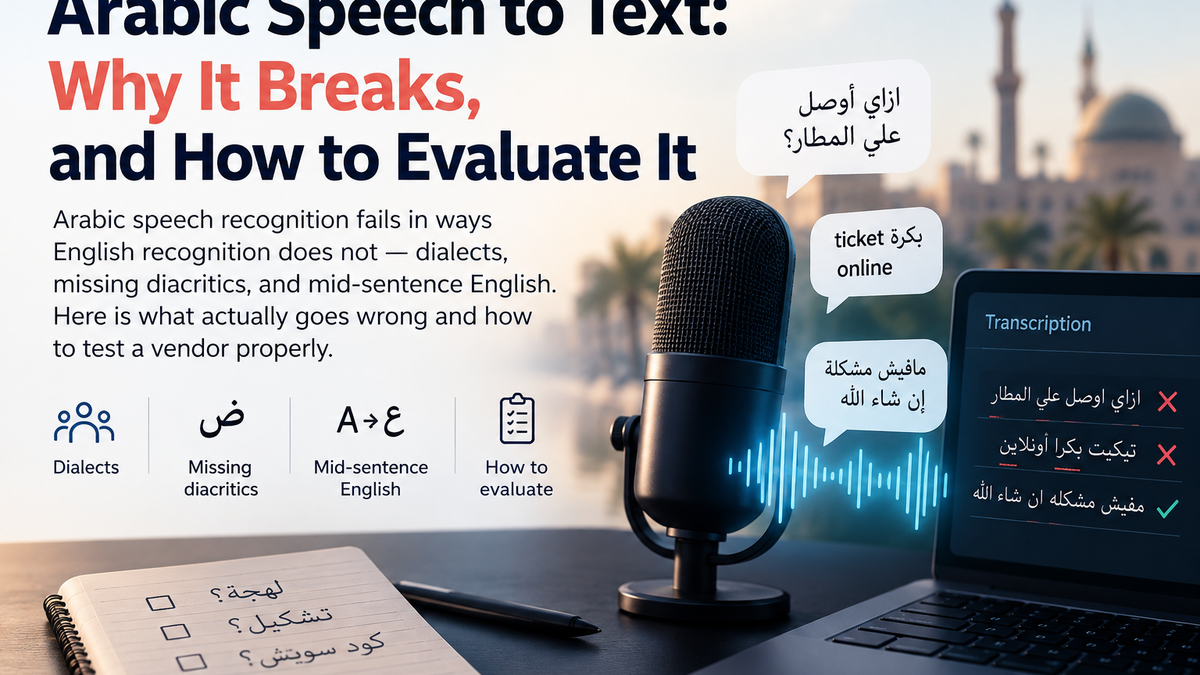
Most speech-to-text demos use a narrator reading clean Modern Standard Arabic. Your customers are not narrators. They send sixteen-second voice notes from a car, in Egyptian or Khaleeji, with an English product name dropped into the middle of the sentence.
That gap is why Arabic transcription tools often score well in a vendor demo and then disappoint on real support audio. This guide explains the three failure modes behind that, and gives you a test you can run before you commit.
Why Arabic is harder than English for speech recognition
It is not that Arabic is intrinsically difficult. It is that three properties stack up in a way they do not for English.
1. The written form and the spoken form are different languages
Modern Standard Arabic is what appears in newspapers, textbooks and news broadcasts. It is nobody's mother tongue. The Arabic people actually speak — Egyptian, Gulf, Levantine, Maghrebi — differs from MSA in vocabulary, verb structure and pronunciation, and the dialects differ from each other enough that a Moroccan and a Kuwaiti may switch to English.
A model trained predominantly on MSA corpora, which is most of the freely available Arabic audio, has effectively learned to transcribe the news. Point it at a customer complaint in Egyptian and word error rates climb sharply.
2. Short vowels are not written
Arabic script omits short vowels. Written Arabic gives the consonantal skeleton, and readers supply the rest from context. Diacritics that mark those vowels exist but appear almost nowhere outside the Quran, poetry and children's books.
For speech recognition this cuts both ways. The model has to produce a written form that drops information present in the audio, and it has to disambiguate words that are distinct in speech but identical once written. Training data with inconsistent diacritisation makes this worse, not better.
3. Code-switching is the norm, not the exception
In Gulf and Egyptian business speech, English nouns, numbers, dates and product names appear inside Arabic sentences constantly. A caller does not pause or signal the switch.
Systems that run language identification first and then transcribe in the winning language will mangle every one of these sentences. The switch has to be handled inside the transcription pass, not before it.
What "95% accurate" is not telling you
Vendors quote word error rate, usually on a benchmark you cannot see. Two things make that number close to meaningless for support audio.
- The benchmark is usually read MSA. Your traffic is spontaneous dialect. These are different tasks and the scores are not comparable.
- Word error rate weights every word equally. Transcribing an order number wrong matters enormously; transcribing a filler word wrong matters not at all. A system can post a good WER and still be useless for support.
What you want to know is narrower and more useful: on your audio, in your dialects, does it get the entities right — order numbers, product names, dates, amounts — and does it flag when it is unsure?
A test you can run in an afternoon
Pull fifty real voice notes or call recordings from your own support queue. Not curated ones, and not the clearest ones. Then:
- Split them by dialect and keep the split visible in your results. An aggregate score hides that a vendor is strong in Egyptian and unusable in Maghrebi.
- Include at least ten with mid-sentence English. Count how many survive the switch intact.
- Include a few recorded in noise — a car, a shop floor, a street. This is where real support audio comes from.
- Score entity accuracy separately from word accuracy. Mark every order number, product name, date and amount, and count only those.
- Check what the system does when it is unsure. Silent guessing is worse than an explicit low-confidence marker, because a guess propagates into whatever acts on the transcript.
Run that same set against every vendor you are considering. It takes an afternoon and it will tell you more than any published benchmark.
Transcription is a means, not the goal
In customer support, an accurate transcript is not the deliverable. Resolving the customer's problem is. That distinction changes what you should be buying.
A standalone transcription API hands you text and stops. Someone still has to read it, work out what was being asked, look up the order, and reply. If the voice note arrived at 2am, that happens the next morning.
What actually shortens the loop is transcription wired into the system that already holds your knowledge base and your ticket history, so the answer can be produced in the same channel the voice note arrived on. That is how Nateq handles Arabic voice — dialect-aware transcription feeding the same agent that answers your chat and email, rather than a separate tool that produces text somebody else has to act on.
Practical guidance
- Test on your own audio before you sign anything. Vendor benchmarks are read MSA and will not predict your results.
- Report accuracy per dialect, never as a single aggregate number.
- Score entities separately — order numbers and product names carry the meaning.
- Require an explicit confidence signal. A system that guesses silently is a system that will be wrong silently.
- Ask what happens after the transcript. If the answer is "you get a string", you have bought half a solution.
If most of your Arabic support arrives as WhatsApp voice notes rather than calls, that changes the shape of what you need — see our guide to Arabic customer support, or book a demo and bring your own recordings to test against.