Guides
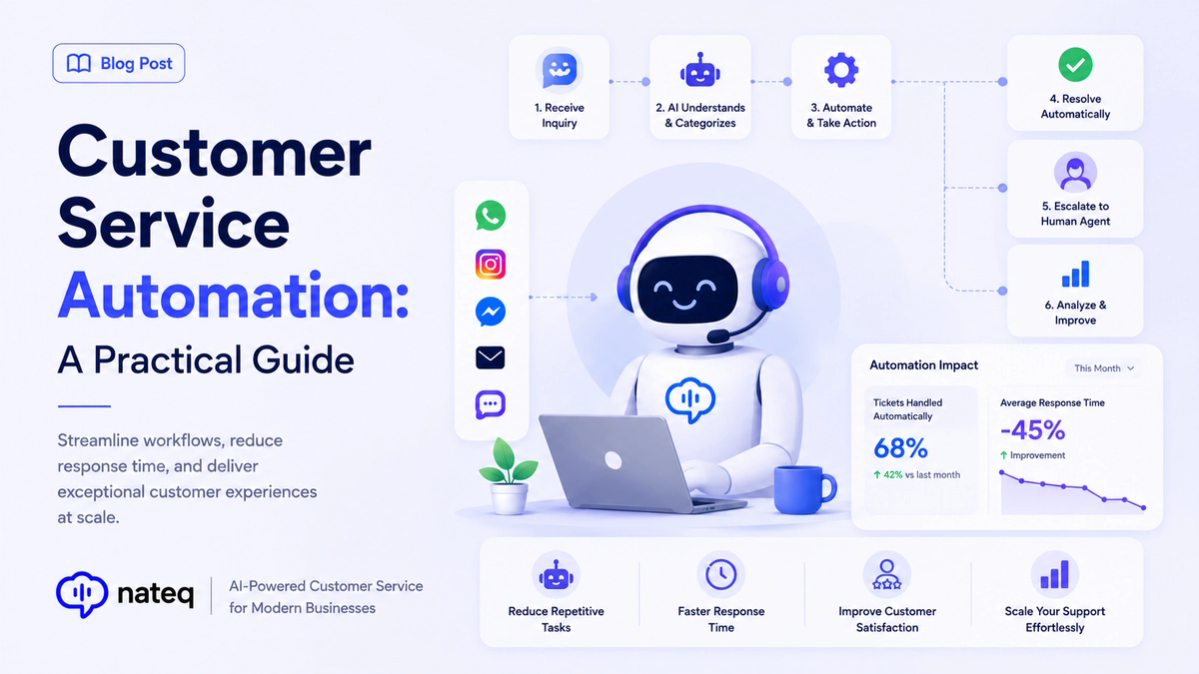
Customer Service Automation: A Practical Guide
Customer service automation handles repetitive work so agents focus on people. Learn what to automate, what to keep human, and how to start.
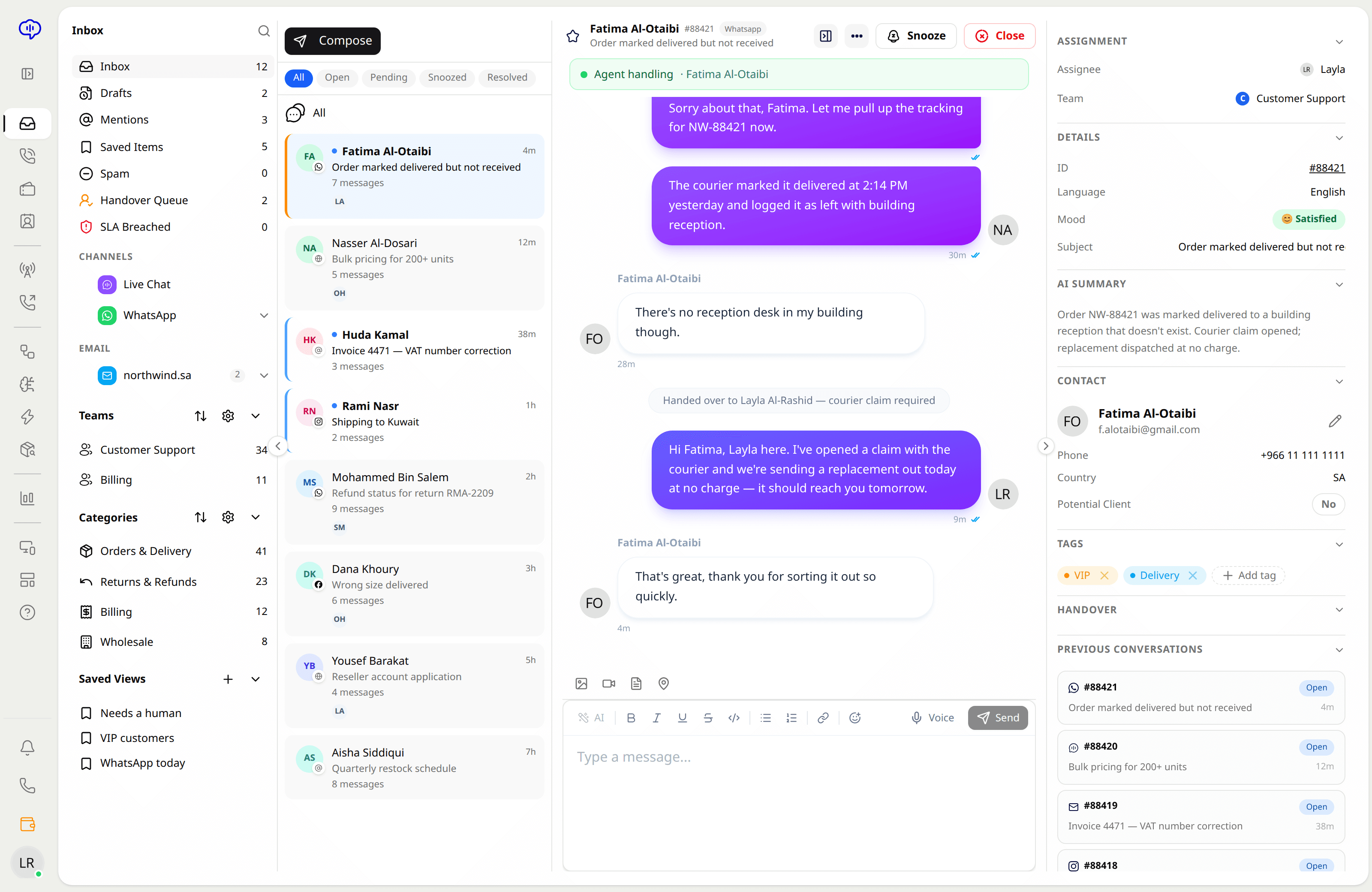
2 min readNateq is a customer service platform for businesses in Saudi Arabia, the UAE and across the GCC. It brings WhatsApp, live chat, calls, email, Instagram and Facebook into one inbox. An AI agent answers in Arabic, English or both, in the customer's own register, and anything it should not handle goes to your team with the whole conversation attached.
In short
Nateq is an AI customer service platform for GCC businesses, built first for Saudi Arabia and the UAE, that serve customers in Arabic and English. It unifies WhatsApp, live chat, voice calls, email, Instagram and Facebook in a single inbox with ticketing, a knowledge base and workflow automation. Its AI agent understands Modern Standard Arabic as well as Gulf, Egyptian, Levantine and Moroccan dialects and Arabizi, replies in the register the customer used, and hands the conversation to a human agent with its full history when needed.
WhatsApp, live chat, calls, email, Instagram and Facebook arrive in one queue. A customer who writes on WhatsApp and follows up by email is one conversation, not two tickets.
Gulf, Egyptian, Levantine and Moroccan dialects, Arabizi, and Arabic and English in the same sentence. The reply comes back in the register the customer used.
Answers come from your own knowledge base, policies and product data, so the agent resolves routine questions instead of deflecting them.
When a conversation needs a person, it moves to an agent with the full history. You decide which topics always go to a human.
Routing, assignment, SLA alerts and escalation rules run without code, so tickets reach the right team without anyone sorting them by hand.
Native integrations with HubSpot, Salesforce, Slack, Microsoft Teams, Jira, Notion, Google Workspace and more, plus a REST API and webhooks.
Yes. Saudi Arabia and the UAE are the two markets it is built for first, and each has its own page. Saudi customers mostly write in Saudi dialects, often on WhatsApp; UAE customers switch between English and Arabic in the same message. Kuwait, Qatar, Bahrain and Oman run from the same inbox, with routing by country and answers from content you write for each market.
Six: WhatsApp Business, live chat on your website, voice calls, email, Instagram direct messages and Facebook Messenger. Each channel keeps its own features (voice notes and media on WhatsApp, attachments on email, recordings and transcripts on calls), and all of them land in the same inbox, under the same routing rules, in front of the same team.
That is the practical difference between a customer service platform and a collection of apps: the history follows the customer, not the channel.
Customers do not write to support in Modern Standard Arabic. A shopper in Riyadh, one in Dubai and one in Cairo will ask the same question in three different ways, and a model that only reads MSA misreads all three. Nateq reads dialects, Arabizi and mixed Arabic-English messages, and answers in the same register instead of switching to formal Arabic.
The interface is built right-to-left from the start: the chat widget, the agent inbox and the help center, with correct punctuation and number handling.
The AI agent takes the first reply on every channel and resolves what it can from your content: order status, opening hours, return policy, the questions your team answers every day. You set its tone, the topics it must never handle, and when it hands over. When it does, the conversation arrives in an agent's queue with the full thread and a summary, so the customer never repeats themselves.
A comparison with the typical global help desk, where Arabic support is added after the fact. It is a comparison by capability, not a claim about any one product.
| Capability | Nateq | Typical global help desk |
|---|---|---|
| Arabic dialects | Gulf, Egyptian, Levantine, Moroccan and Arabizi, answered in the same register | Usually Modern Standard Arabic, often through a translation layer |
| Right-to-left interface | Built RTL: widget, agent inbox and help center | Often a mirrored left-to-right layout |
| WhatsApp voice notes | Transcribed and answered in the same thread | Usually left for an agent to play back |
| Knowledge base languages | One set of articles answers in Arabic and English | Often a separate translated article per language |
| Voice | Calls in the same inbox, with an Arabic voice agent | Often a separate add-on or product |
Link your WhatsApp Business Account, add the chat widget to your site, forward your support email and connect Instagram and Facebook.
Import help articles, policies and FAQs in Arabic, English or both. The agent answers in whichever language the customer uses.
Decide what the agent handles, what always goes to a person, and how tickets are routed. Review conversations and correct answers as you go.
Software that brings every customer conversation, whatever the channel, into one place where a team can answer, track and automate it. Nateq adds an AI agent that answers first, in Arabic or English, and hands over to your team when needed.
Nateq is built for it. Its AI agent reads Gulf, Egyptian, Levantine and Moroccan Arabic as well as Arabizi and mixed Arabic-English messages, and replies in the same register. The whole interface is right-to-left.
A help desk is mainly about tickets. A customer service platform also covers the channels the conversations arrive on, the AI that answers them, the knowledge base behind the answers, and the automation that routes them. Nateq includes all of these.
Yes. You connect your own WhatsApp Business Account, and conversations appear in the same inbox as your other channels. Meta bills message delivery to that account directly, at Meta's published rates, with no markup from Nateq.
Yes. You choose the topics that always go to a person and the conditions for handing over. The agent passes the full conversation and a summary, so your team picks up where it left off.
In the EU (Frankfurt) today. Further regions are available on request; the pricing page lists the current status.
You can start free. Paid plans are priced by the work the platform does rather than by seat. The pricing page has the current plans.
Customer service automation handles repetitive work so agents focus on people. Learn what to automate, what to keep human, and how to start.
2 min read
AI customer service uses artificial intelligence to answer questions, route tickets, and support agents. Here is how it works and why it matters.
2 min read
Omnichannel customer support unifies every channel into one connected experience. Learn what it means, how it differs from multichannel, and how to deliver it.
2 min readBring every conversation into one intelligent platform — free during early access.