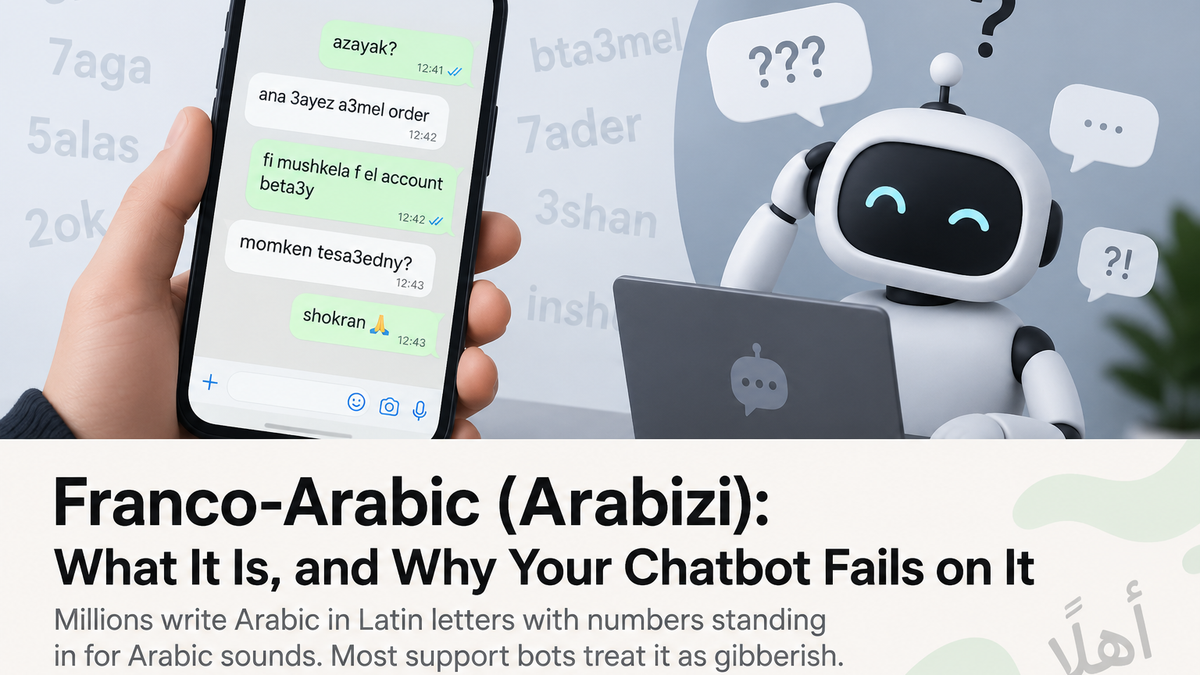
A customer writes "el order wasal wala lsa?" and your chatbot replies that it did not understand. The customer types it again, gets the same answer, and asks for a human — or leaves.
That message is ordinary Egyptian Arabic. It is written in Latin letters, with digits standing in for Arabic sounds that Latin script has no letter for. It is called Franco-Arabic in Egypt and the Levant, Arabizi in academic writing, and it is one of the most common ways Arabic is typed online.
How the system works
Franco-Arabic maps Arabic to the Latin alphabet, and where no Latin letter fits, it borrows a digit whose shape resembles the Arabic letter.
- 2 stands for hamza (ء) — "so2al" for سؤال, question
- 3 stands for ain (ع) — "3arabi" for عربي, Arabic
- 5 or kh stands for kha (خ) — "5alas" or "khalas" for خلاص
- 7 stands for ha (ح) — "7abibi" for حبيبي
- 8 or gh stands for ghain (غ) — "8ali" for غالي, expensive
- 9 stands for sad (ص) in some regional conventions
The digit choices are visual: 3 resembles a reversed ع, 7 resembles ح. Nobody standardised this. It emerged from early mobile keyboards and chat clients that could not type Arabic, and it stuck long after that constraint disappeared.
Why it persists
The original reason — no Arabic keyboard — is gone. Franco-Arabic did not go with it, for reasons worth understanding if you are deciding whether to support it.
- Habit. A generation learned to type this way and never switched.
- Speed. Many people type Latin faster, especially when mixing in English words.
- Mixed-language messages. When half a sentence is an English product name, staying in one script is simpler than switching keyboards mid-message.
- Register. Franco-Arabic reads as casual. Some people use Arabic script for formal writing and Franco for chat, and support conversations feel like chat.
It is most common in Egypt and the Levant, and among younger users everywhere. If your customers skew young or Egyptian, expect a meaningful share of your inbound support to arrive this way.
Why bots fail on it
Three distinct failures, worth separating because they have different fixes.
Language detection misfires
A detector sees Latin characters and reports English. Everything downstream then treats Egyptian Arabic as broken English. This is the most common failure and the most damaging, because it happens before the model sees the message.
No training coverage
Models trained on Arabic script and English text have seen little Franco-Arabic. It is neither, and it is under-represented in most corpora.
Inconsistent spelling
There is no standard. The same word appears as "khalas", "5alas", "khlas". A system relying on exact matching or a keyword list fails on the variants it was not given.
What good handling looks like
- Detect Franco-Arabic as Arabic, not as English. This single fix resolves most of the damage.
- Handle spelling variation rather than exact matches. "5alas" and "khalas" are the same word.
- Handle scripts mixed within one message — Latin, Arabic and English often appear in a single sentence.
- Reply in Arabic script. Most people who write Franco read Arabic script comfortably; answering in Franco reads as odd from a brand.
- Never ask the customer to rewrite their message. That is the system telling the customer to do its job.
Nateq reads Franco-Arabic as Arabic, including mid-message script switches, and answers in the register the customer used — see how the Arabic chatbot handles it.
A quick way to test any vendor
Send these three messages and watch what comes back:
- "el order bta3i wasal?" — plain Franco-Arabic. Does it understand, or claim not to?
- "3ayez a3mel return lel order 4471" — Franco with an English word and a number. Does the order number survive?
- "khalas shokran" then "5alas shukran" — the same phrase, two spellings. Does it treat them as the same?
If a vendor fails these, it will fail on a significant share of your real inbound traffic, whatever its Arabic benchmark scores say.
For the wider picture, see Arabic customer support best practices, or book a demo and test it with your own messages.