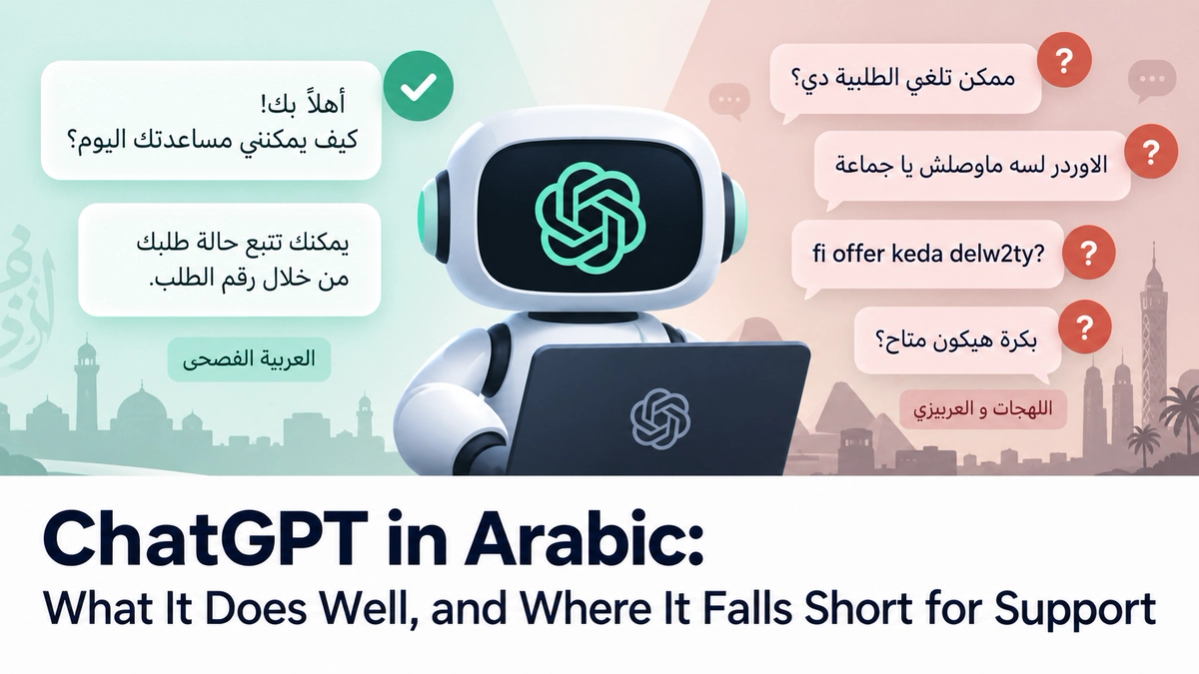
General-purpose assistants write good Modern Standard Arabic. That is genuinely useful, and it is also the source of a common misreading: that Arabic is now a solved problem, and any Arabic support workload can be handed to a general model.
The reality is more specific. Performance is strong in MSA, uneven across dialects, and weakest exactly where customer support lives.
What general models do well in Arabic
- Modern Standard Arabic prose. Formal writing, summaries and translation into MSA are reliably good.
- Comprehension of dialect input. Understanding an Egyptian or Gulf message is usually fine, even when producing that dialect is not.
- Translation between Arabic and English, including technical vocabulary.
- General knowledge questions asked in Arabic.
If your need is drafting, summarising or translating, a general model covers it. The problems start when the output has to be a reply sent to a customer.
Where it falls short
It answers in the wrong register
Ask in Khaleeji, get an answer in formal MSA. The response is grammatically correct and reads as though it came from a government circular. In a support context that is a real cost: it signals that the brand did not quite understand you, and it lands differently from the message the customer actually sent.
Dialect generation is much harder than dialect comprehension, and the training data is far thinner. Egyptian tends to be the strongest dialect because it dominates Arabic media; Maghrebi is usually the weakest.
It does not know your business
This is the decisive one and it is not really about Arabic. A general model has no access to your return policy, your delivery windows, your pricing tiers or this customer's order. Asked about them it will either refuse or produce something plausible and wrong, and in Arabic the fluent output makes the error harder to spot.
It has no path to a human
Customer support is not a series of independent questions. It is a conversation with state, and some conversations must reach a person. A chat interface has no concept of escalation, no ticket, no history, and no way to hand a conversation over with context attached.
A useful way to draw the line
Ask what happens when the model is wrong.
If a draft comes back slightly off, you fix it before sending — the cost is a few seconds. If a customer-facing agent invents a refund window that does not exist, you have made a commitment in writing, in your brand's voice, to a customer who will hold you to it. Same model, entirely different risk.
That is the distinction that matters: not whether the model speaks Arabic, but whether it is grounded in your policies and able to stop when it should.
What a support-grade Arabic agent adds
- Answers drawn from your own knowledge base and policies rather than general training, so the reply reflects what your company actually does.
- Replies in the register the customer used, instead of defaulting everyone to formal MSA.
- Access to order and account state, so "where is my order" has a real answer.
- Explicit limits — topics it will never answer alone, and a clean handoff to a person with the conversation history attached.
- A review trail, so a wrong answer can be corrected once and stay corrected.
That is the difference between a capable general model and a deployable support agent. If you want to see what the second looks like in Arabic, including how it handles dialect and Latin-script input, see Nateq's Arabic chatbot.
If you are evaluating one
- Test with real customer messages in your customers' dialects, not MSA you wrote for the test.
- Check what register comes back. Formal MSA answering colloquial Arabic is a signal, not a rounding error.
- Ask a question only your business can answer and see whether it refuses or invents.
- Include messages written in Latin script — a meaningful share of real Arabic support arrives that way.
- Try to escalate. If there is no way to reach a human with context, it is not a support system yet.
For the broader picture of running Arabic support well, see Arabic customer support best practices, or book a demo.