Lucidya is a well-known customer service tool, and teams pick it for good reasons. But support in Saudi Arabia, the UAE and the wider GCC rarely looks like support in the markets most of these tools were designed around.
Here, many customers don't open a ticket or send an email. They send a WhatsApp voice note, an Instagram DM, or a message that moves between Gulf Arabic, English and Franco-Arabic in the same sentence, and then they call. Teams end up joining a help desk, a WhatsApp tool, a phone system and an AI layer that struggles with dialect, and paying for each one.
If that sounds familiar, this guide is for you. We compared 4 alternatives to Lucidya on the things that decide it for GCC support teams, using each vendor's own public pages, and wrote down who each one actually suits, including when that isn't us.
Short on time?
- Nateq — best for GCC teams on WhatsApp who need Arabic dialect AI and calls in one inboxOur product
- Zendesk — best for larger support teams that want a mature ticketing suite with a large app marketplace, and can budget per agent plus usage-based AI resolutions
- respond.io — best for sales-led teams that live on WhatsApp and other messaging apps and want lead management and broadcasts priced per workspace with included users
- Freshdesk — best for teams centred on email ticketing and a knowledge base that want an established help desk at a moderate per-agent price
Disclosure: Nateq is our product. It is listed first and labelled as ours. Every statement about another product comes from that vendor's public pages, linked in its section, and was checked on the date shown.
What is Lucidya?
Lucidya is a customer experience platform to monitor conversations, analyse sentiment and engage customers; its OmniServe inbox handles social media, WhatsApp, email and web chat with AI that understands Arabic dialects.
Lucidya's public pages list the WhatsApp Business Platform (API), instagram DMs, facebook Messenger, website live chat, an email inbox, arabic language support, gulf Arabic understanding, handoff to a human, ticketing, workflow automation, data hosting in the GCC and a SOC 2 report as part of the product.
Phone calls are sold as a paid add-on (Phone interactions through the Call Analytics add-on).
The AI agent is billed by use (100 conversations per seat included).
HubSpot and Salesforce integrations are partly supported (Salesforce profile sync; HubSpot not named).
Lucidya publishes these plans: Growth at $125 per seat / month, minimum 6 seats; Enterprise at $250 per seat / month, minimum 12 seats.
It suits brands whose customer care runs largely on public social media and that also want social listening and sentiment analytics from the same vendor.
Sources: lucidya.com, lucidya.com/pricing/omniserve, lucidya.com/products/omniserve, lucidya.com/security-practices
Why GCC teams look for a Lucidya alternative
Most teams don't leave Lucidya because it is a bad product. They leave because the way their customers reach them has changed. These are the needs that most often decide it:
- 01
Customers write in dialect, not textbook Arabic
A customer in Riyadh and a customer in Dubai phrase the same question differently, and many mix in English or Latin-script Arabic. An AI agent trained mostly on Modern Standard Arabic can misread the intent and reply in a register that feels wrong to the customer.
- 02
WhatsApp is the main channel, not an extra
When most conversations start on WhatsApp and Instagram, those channels need the same routing, SLAs and reporting as email, in the same inbox, rather than a separate tool or a plan upgrade.
- 03
Calls live in a separate tool
Customers in the region still pick up the phone, often right after messaging. When voice runs in another system, agents lose the context of the chat and managers lose the full picture of the customer.
- 04
The bill grows with every add-on
Seats, messaging, voice and AI priced separately make it hard to predict what support will cost next quarter, especially when AI is billed per resolution and volume grows. On Lucidya, for example: phone calls are sold as a paid add-on (Phone interactions through the Call Analytics add-on).
What makes a good Lucidya alternative?
We looked at every tool through the same four questions. You may weigh them differently, so here is what each one means in practice.
- Arabic as customers write it. Can the AI understand Gulf and other dialects, Franco-Arabic and mixed Arabic and English, and reply naturally in the same register? Test it on your own customers' messages, not on a demo script.
- WhatsApp and social in the same inbox. Are messaging channels handled with the same ticketing, assignment and SLAs as email, and on which plan?
- Calls in one place. Can agents take phone and WhatsApp calls next to the chat history, without switching tools or buying a separate product?
- Predictable pricing. Does the cost scale by seat, by usage, by AI outcome or by workspace, and what happens to the bill as your volume grows?
Lucidya alternatives at a glance
The alternatives side by side with Lucidya. Scroll sideways on smaller screens.
| NateqOur product | LucidyaCurrent tool | Zendesk | respond.io | Freshdesk | |
|---|---|---|---|---|---|
| Pricing | Per seat; calls on every plan | From $125 per seat / month, minimum 6 seats | From $19 per agent / month, billed yearly ($25 monthly) | From $79 per month billed yearly, 5 users included | From $19 per agent / month, billed annually |
| Every plan; Meta bills you directly | Included | Suite plans; additional fees apply | Official API; badged Meta Business Partner | Freshdesk Omni only, not standard Freshdesk | |
| Calls in the inbox | Every plan | Phone interactions through the Call Analytics add-on | Suite Team and up; numbers are an add-on | Calls channel; plan availability not stated | Through the Freshcaller integration |
| AI agent | Prepaid wallet per resolution | 100 conversations per seat included | 5–10 automated resolutions per agent included; extra $1.50–$2.00 each | Growth plan and up | Freddy AI Agent; 500 sessions included, then $49 per 100 |
| Gulf Arabic | Gulf, Franco-Arabic and mixed | 15 Arabic dialects, from Khaliji to Maghrebi | Not in the sources we checked | Not in the sources we checked | Not in the sources we checked |
| Free trial | 14 days, no card | Start free, no credit card | 14 days | 7 days | 14 days |
From each vendor's public pages, checked 13 October 2026. Sources are listed in each section below.
Alternative 01Our product
1. Nateq
Best for GCC businesses whose customers write in Arabic dialects on WhatsApp and social media, and who want calls in the same inbox.
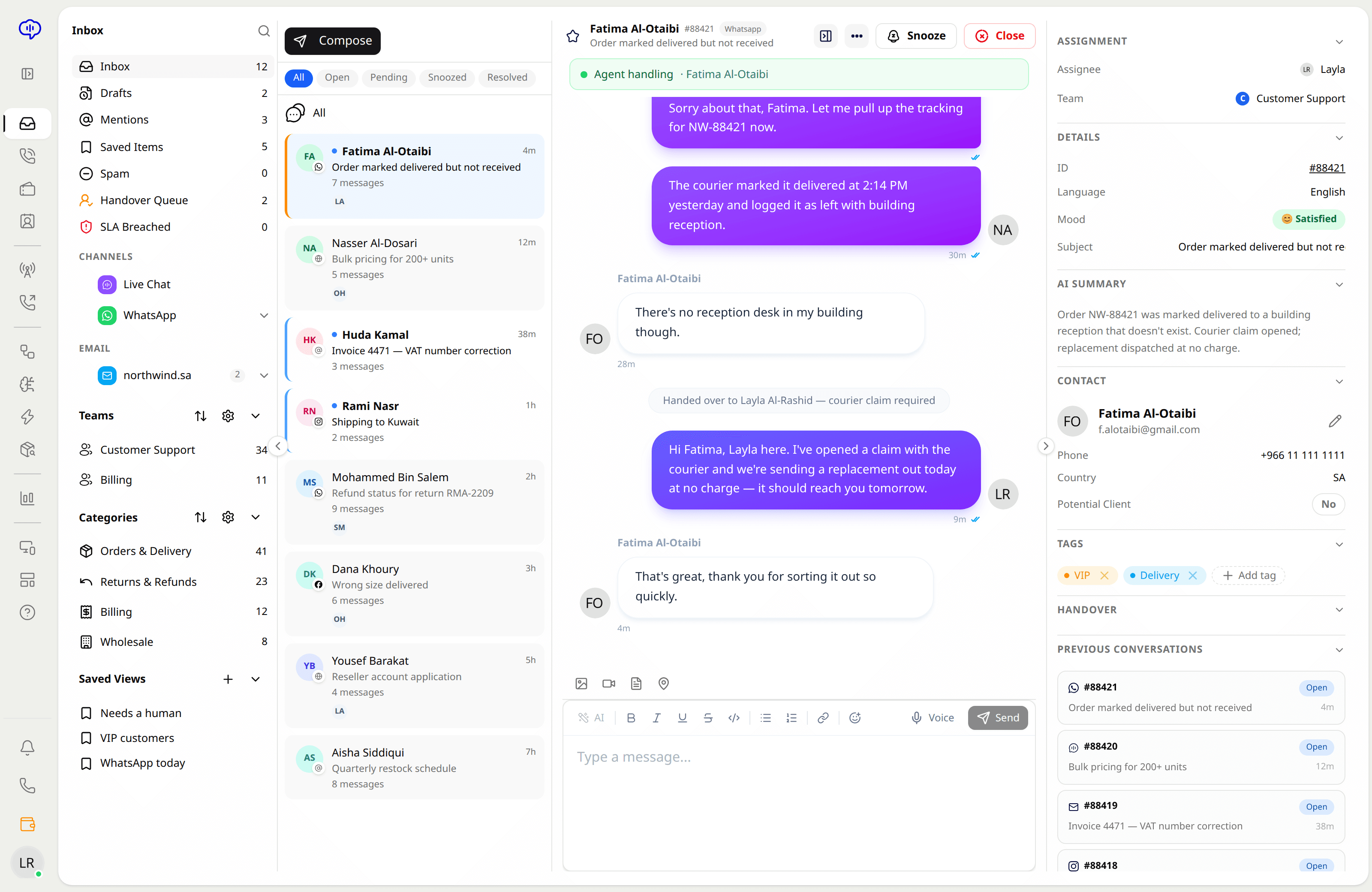
We built Nateq for the way customers in Saudi Arabia, the UAE and the GCC actually get in touch. WhatsApp, Instagram, Facebook, website chat, email and phone calls all land in one shared inbox, with ticketing, assignment and SLAs working the same way on every channel.
The AI agent is usually the part teams notice first. It reads Gulf Arabic, including Saudi, alongside other dialects, Franco-Arabic and Arabic and English mixes, and replies in the register the customer used. It answers from your own help articles and policies, and when it hands a conversation to a person, the agent sees the full history and a summary in one timeline.
Calls are included on every plan rather than sold as a separate product. Agents take phone and WhatsApp calls from the inbox, and an Arabic AI voice agent can answer routine calls, billed per minute from a prepaid wallet.
Key features
- Shared inbox for WhatsApp, Instagram, Facebook, web chat, email and calls
- AI agent for Gulf Arabic, other dialects, Franco-Arabic and mixed Arabic and English
- Arabic AI voice agent for inbound calls
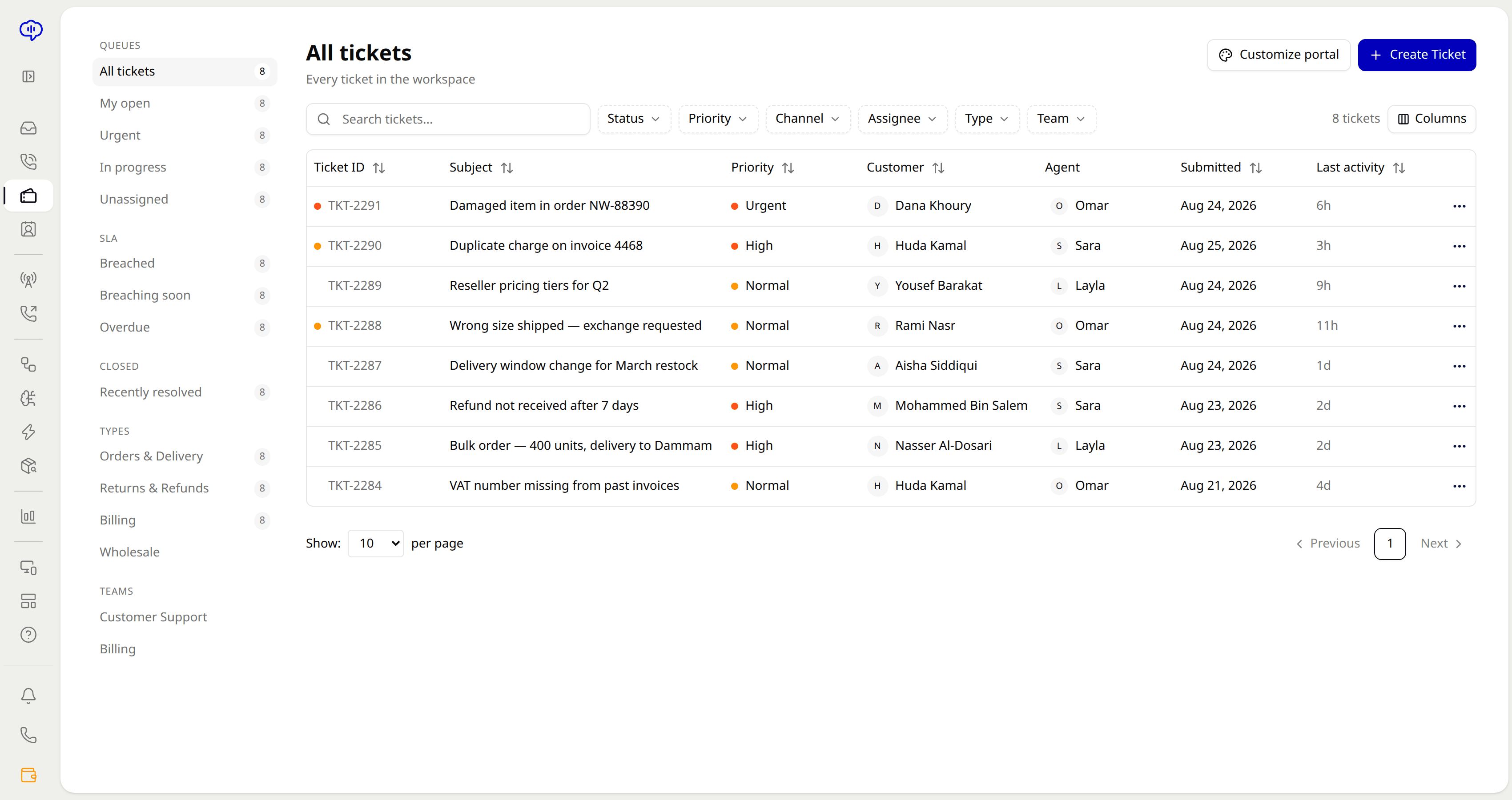
- Ticketing, routing, SLAs and reporting on every channel
- Payment links through Moyasar (mada, Apple Pay), Tap and Stripe
Pros
- + Arabic AI that understands dialect and code-switching
- + Messaging and calls in one inbox on every plan
- + Meta bills WhatsApp to you directly, with no Nateq markup
Cons
- – Data is hosted in the EU (Frankfurt), not the GCC
- – No SOC 2 report yet
- – A younger product: check that our integrations cover your stack
Pricing: Per seat per month, with every channel and calls included. AI resolutions and voice minutes come from a prepaid wallet, and Meta bills WhatsApp to you directly. 14-day free trial, no card required.
Alternative 02
2. Zendesk
Larger support teams that want a mature ticketing suite with a large app marketplace, and can budget per agent plus usage-based AI resolutions.
Zendesk describes itself as an AI-first service platform: ticketing, messaging, voice, a help center and AI agents, sold per agent in Support and Suite plans.
Zendesk's public pages list website live chat, an email inbox, arabic language support, handoff to a human, ticketing, a knowledge base, workflow automation, hubSpot and Salesforce integrations and a SOC 2 report as part of the product.
Key features
- WhatsApp Business Platform (API) inbox (Suite plans; additional fees apply)
- Instagram DMs (Suite plans)
- Facebook Messenger (Suite plans)
- Website live chat
- Email inbox
- Phone calls in the same inbox (Suite Team and up; numbers are an add-on)
- Arabic language support (Listed for AI agents; no Gulf or Saudi dialect named)
- Handoff to a human with full history (AI agent escalates to a human agent on messaging)
- Ticketing and SLAs
- Knowledge base / help center
- Workflow automation
- HubSpot and Salesforce integrations (HubSpot integration (one-way); Salesforce connector in the marketplace)
- SOC 2 Type II report (Type II reports on request, under NDA)
- Free trial (14 days)
Pros
- + AI agents included on every Support and Suite plan, with a monthly allowance of automated resolutions
- + A help center in 40+ languages on Suite Professional
- + Marketplace apps and APIs to extend the suite
Trade-offs to check
- – The WhatsApp Business Platform (API) is available on some plans only (Suite plans; additional fees apply).
- – Instagram DMs are available on some plans only (Suite plans).
- – Facebook Messenger is available on some plans only (Suite plans).
- – Phone calls are available on some plans only (Suite Team and up; numbers are an add-on).
- – The AI agent is billed by use (5–10 automated resolutions per agent included; extra $1.50–$2.00 each).
- – An AI voice agent is billed by use (Voice AI agents; charged for connected time plus telephony).
- – Data hosting in the GCC is not offered (Hosting regions: US, EEA, UK, Japan, Australia).
Pricing: Zendesk publishes these plans: Support Team at $19 per agent / month, billed yearly ($25 monthly); Suite Team at $55 per agent / month, billed yearly ($69 monthly); Suite Professional at $115 per agent / month, billed yearly ($149 monthly). Source ↗
Nateq vs ZendeskSources: zendesk.com, zendesk.com/pricing, support.zendesk.com/hc/en-us/articles/8357749663130-Languages-supported-by-AI-agents, support.zendesk.com/hc/en-us/articles/10169333291290-About-voice-AI-agents, support.zendesk.com/hc/en-us/articles/10412442245914-Workflow-recipe-Using-an-AI-agent-to-collect-customer-info-and-immediately-escalate-to-a-human-agent, support.zendesk.com/hc/en-us/articles/4408884090650-Setting-up-the-Zendesk-Support-for-HubSpot-integration, support.zendesk.com/hc/en-us/articles/4408838409754-About-the-Data-Center-Location-add-on, zendesk.com/trust-center
Alternative 03
3. respond.io
Sales-led teams that live on WhatsApp and other messaging apps and want lead management and broadcasts priced per workspace with included users.
respond.io is an AI-powered customer conversation platform that brings messaging channels and CRMs into one team inbox with AI agents and lead management.
respond.io's public pages list the WhatsApp Business Platform (API), instagram DMs, facebook Messenger, website live chat, an email inbox, phone calls, arabic language support, handoff to a human and hubSpot and Salesforce integrations as part of the product.
Key features
- WhatsApp Business Platform (API) inbox (Official API; badged Meta Business Partner)
- Instagram DMs
- Facebook Messenger
- Website live chat (Website Chat widget)
- Email inbox
- Phone calls in the same inbox (Calls channel; plan availability not stated)
- AI agent that replies to customers (Growth plan and up)
- Arabic language support (Arabic among the Voice AI Agent's voices)
- AI voice agent on the phone (Advanced plan and up; inbound calls only, up to 3 minutes each)
- Handoff to a human with full history (AI agent assigns to a human or team with context)
- Workflow automation (Growth plan and up)
- HubSpot and Salesforce integrations
- Free trial (7 days)
Pros
- + Official WhatsApp API from a badged Meta Business Partner
- + Plans include users — 5 on Starter, 10 on Growth — instead of pricing every seat
- + HubSpot and Salesforce integrations
Trade-offs to check
- – The AI agent is available on some plans only (Growth plan and up).
- – An AI voice agent is available on some plans only (Advanced plan and up; inbound calls only, up to 3 minutes each).
- – A knowledge base is partly supported (AI Agent knowledge sources (files, websites); no customer-facing help center).
- – Workflow automation is available on some plans only (Growth plan and up).
Pricing: respond.io publishes these plans: Starter at $79 per month billed yearly, 5 users included; Growth at $159 per month billed yearly, 10 users included; Advanced at $279 per month billed yearly, 10 users included. Source ↗
Nateq vs respond.ioSources: respond.io, respond.io/pricing, respond.io/whatsapp-api, respond.io/help/website-chat-widget/website-chat-widget-overview, respond.io/help/ai-agent-actions/ai-agent-action-handle-calls, respond.io/help/ai-agents/getting-started-with-ai-agents
Alternative 04
4. Freshdesk
Teams centred on email ticketing and a knowledge base that want an established help desk at a moderate per-agent price.
Freshdesk, from Freshworks, is an AI-powered customer service solution with omnichannel ticketing and automated workflows.
Freshdesk's public pages list facebook Messenger, an email inbox, handoff to a human, ticketing, a knowledge base, workflow automation, hubSpot and Salesforce integrations, data hosting in the GCC and a SOC 2 report as part of the product.
Key features
- WhatsApp Business Platform (API) inbox (Freshdesk Omni only, not standard Freshdesk)
- Instagram DMs (Freshdesk Omni only)
- Facebook Messenger (Freshdesk and Freshdesk Omni)
- Email inbox
- Handoff to a human with full history (Configurable handover from the AI agent to human agents)
- Ticketing and SLAs
- Knowledge base / help center
- Workflow automation
- HubSpot and Salesforce integrations (HubSpot and Salesforce connector apps)
- Data hosted in the GCC (UAE data center, chosen at sign-up)
- SOC 2 Type II report (SOC 2 Type 2 report on request)
- Free trial (14 days)
Pros
- + Freddy AI Agent on every plan, with 500 sessions included
- + Ticketing, a knowledge base and automations on every plan
- + An entry plan at $19 per agent per month, billed annually
Trade-offs to check
- – The WhatsApp Business Platform (API) is available on some plans only (Freshdesk Omni only, not standard Freshdesk).
- – Instagram DMs are available on some plans only (Freshdesk Omni only).
- – Website live chat is partly supported (Basic web chat in Freshdesk; full live chat in Freshdesk Omni).
- – Phone calls are sold as a paid add-on (Through the Freshcaller integration).
- – The AI agent is billed by use (Freddy AI Agent; 500 sessions included, then $49 per 100).
- – Arabic language support is partly supported (Live Translate lists Arabic; the AI Agent page names no languages).
- – An AI voice agent is sold as a paid add-on (Third-party Freshcaller Marketplace apps (Synthflow, SquawkVoice)).
Pricing: Freshdesk publishes these plans: Growth at $19 per agent / month, billed annually; Pro at $55 per agent / month, billed annually; Enterprise at $89 per agent / month, billed annually. Source ↗
Nateq vs FreshdeskSources: freshworks.com/freshdesk, freshworks.com/freshdesk/pricing, support.freshdesk.com/support/solutions/articles/50000011785-getting-started-with-freshdesk-omni, support.freshdesk.com/support/solutions/articles/50000011658-live-translate-in-freshdesk, freshworks.com/freshcaller-cloud-pbx/new-features, support.freshdesk.com/support/solutions/articles/50000012026-configure-handover-settings-for-ai-agents, freshworks.com/apps/freshdesk/collection/connector_apps, support.freshdesk.com/support/solutions/articles/235810-where-is-your-data-servers-located-, trust.freshworks.com
How to choose the right Lucidya alternative
There is no single best tool, only the best fit for where your customers are and how your team works. Start with the situation that sounds most like yours:
Most customers message you on WhatsApp or Instagram in Arabic, and often call too.
NateqLarger support teams that want a mature ticketing suite with a large app marketplace, and can budget per agent plus usage-based AI resolutions.
ZendeskSales-led teams that live on WhatsApp and other messaging apps and want lead management and broadcasts priced per workspace with included users.
respond.ioTeams centred on email ticketing and a knowledge base that want an established help desk at a moderate per-agent price.
FreshdeskWhichever way you lean, test your shortlist on real conversations. Take a week of WhatsApp messages in your customers' own dialect and see which tool understands them.
Switching from Lucidya
Trying Nateq without pausing support
You don't have to switch everything at once. Run both tools in parallel and compare them on live conversations before you move anything.
Step 1
Start the trial
14 days, no card. Keep Lucidya running.
Step 2
Connect one channel
WhatsApp is the usual start. Import your help articles so the AI agent answers from them.
Step 3
Compare on live traffic
Run both side by side before you move anything.
The verdict
Lucidya remains a reasonable choice for brands whose customer care runs largely on public social media and that also want social listening and sentiment analytics from the same vendor. If that no longer describes your team, the right alternative comes down to three questions: which channels your customers use, which Arabic they write, and whether you want calls in the same place as chat.
Zendesk fits larger support teams that want a mature ticketing suite with a large app marketplace, and can budget per agent plus usage-based AI resolutions. respond.io fits sales-led teams that live on WhatsApp and other messaging apps and want lead management and broadcasts priced per workspace with included users. Freshdesk fits teams centred on email ticketing and a knowledge base that want an established help desk at a moderate per-agent price. And if your customers mostly message you on WhatsApp in Gulf Arabic and then call, we built Nateq for exactly that.
Frequently asked questions
What is the best alternative to Lucidya?
It depends on your channels and customers. For GCC teams on WhatsApp who need Arabic dialect support and calls in the same inbox, Nateq. Zendesk fits larger support teams that want a mature ticketing suite with a large app marketplace, and can budget per agent plus usage-based AI resolutions. respond.io fits sales-led teams that live on WhatsApp and other messaging apps and want lead management and broadcasts priced per workspace with included users. Freshdesk fits teams centred on email ticketing and a knowledge base that want an established help desk at a moderate per-agent price.
Why is Nateq listed first?
Nateq is our product, and we say so. Every statement about the other tools comes from that vendor's public pages, linked in its section, so you can check it yourself.
Is there a Lucidya alternative that understands Gulf Arabic?
Nateq's AI agent reads Gulf Arabic including Saudi, other dialects, Franco-Arabic and Arabic and English mixes, and replies in the same register. Whatever you shortlist, test it on a sample of your real conversations.
Which Lucidya alternative handles WhatsApp best?
Nateq puts WhatsApp in the same inbox as every other channel on every plan, and Meta bills the messages to you directly with no Nateq markup. Zendesk: Suite plans; additional fees apply. respond.io: Official API; badged Meta Business Partner. Freshdesk: Freshdesk Omni only, not standard Freshdesk.
How is Nateq priced compared with Lucidya?
Per seat per month, with every channel and calls included. AI resolutions and voice minutes come from a prepaid wallet, and Meta bills WhatsApp to you directly. 14-day free trial, no card required. Lucidya publishes these plans: Growth at $125 per seat / month, minimum 6 seats; Enterprise at $250 per seat / month, minimum 12 seats.
Can I try Nateq alongside Lucidya?
Yes. The 14-day trial needs no card: connect one channel, import your help articles, and compare both on live conversations before you move anything.